
For many artists, one of the biggest questions in music today is simple: how does Spotify actually pay?
You’ve probably heard numbers like “$0.003 per stream,” but the reality is more complex. Spotify does not operate on a fixed per-stream payment system. Instead, it uses a revenue-sharing model that determines payouts based on overall activity across the platform.
Understanding how this system works is essential for any artist trying to make sense of their streaming income.
Start With the Big Idea
Spotify works on what is known as a pro-rata model.
Each month, the platform pools all the money it generates from:
- Premium subscriptions
- Advertising revenue
From that total, Spotify keeps roughly 30%, while about 70% is paid out to rights holders including record labels, distributors, publishers, and collecting societies.
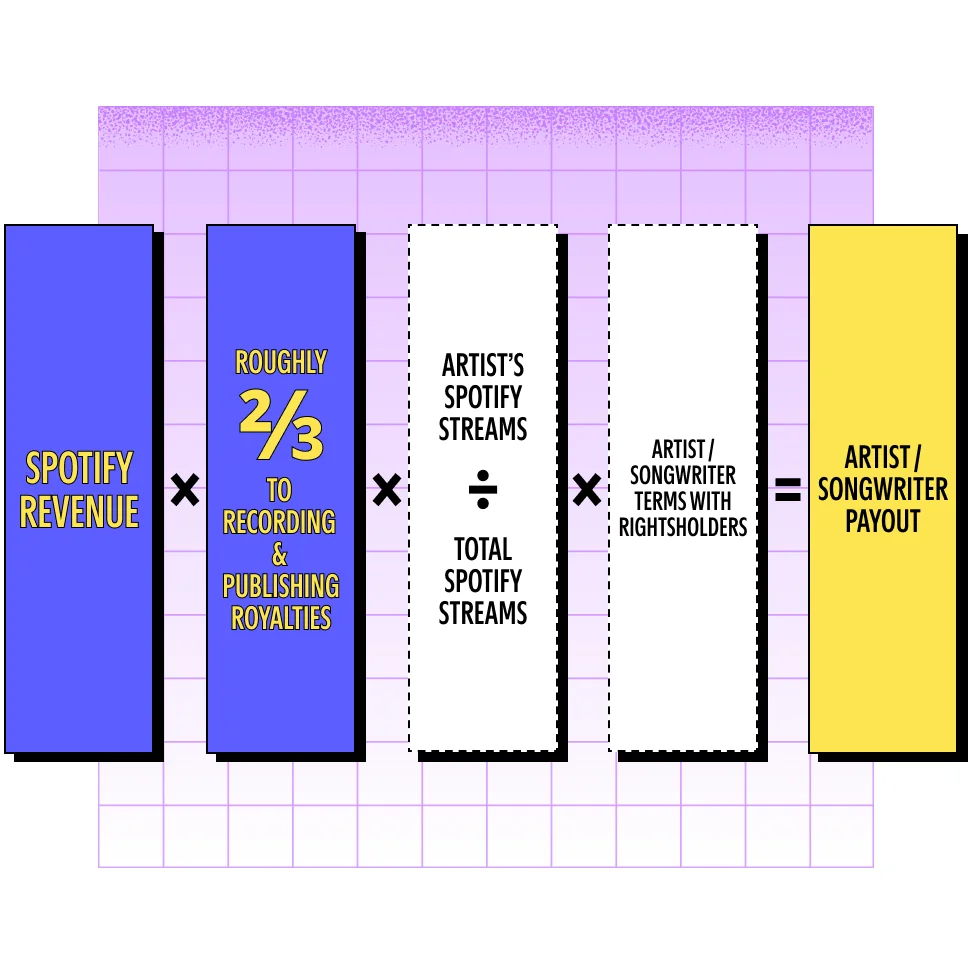
The key point is this: Spotify does not pay per stream. It pays based on your share of total streams
What “Streamshare” Means
Spotify calculates something called streamshare. This is how it works:
- Spotify counts the total number of streams across the platform in a given period
- It then calculates what percentage of those streams belong to your music
For example:
If your songs account for 1% of all streams, your rights holders receive 1% of the royalty pool for that period.
This is why the “per-stream rate” is not fixed. The value of a stream changes depending on:
- Total platform activity
- Listener location
- Subscription vs free users
That’s why estimates like $0.003–$0.005 per stream are only averages, not guarantees.
Who Actually Gets Paid
Another common misunderstanding is that Spotify pays artists directly.
It doesn’t.
Spotify pays rights holders, and the money flows through multiple layers before reaching the artist.
There are two main types of royalties:
- Recording royalties
These go to whoever owns the master recording, usually a record label or distributor. - Publishing royalties
These go to songwriters and composers through publishers, collecting societies, and mechanical agencies.
Once Spotify calculates your streamshare and sends payments, those rights holders then pay artists and songwriters based on their individual agreements.
How Independent Artists Get Paid
If you’re an independent artist, the process is slightly simpler.
Instead of a label, you use a distributor like DistroKid, TuneCore, or CD Baby.
Here’s the flow:
- You upload your music through a distributor
- Spotify calculates your earnings based on streamshare
- Spotify pays your distributor
- The distributor deposits your earnings into your account
- You withdraw the money
Even then, fees may apply depending on the distributor you use.
Why Spotify Payouts Feel Low
Many artists feel streaming payouts are small, and they’re not wrong.
There are a few reasons for this:
- The system is volume-based, meaning you need large numbers of streams
- Revenue is shared across millions of artists
- Free-tier users generate less income than premium subscribers
- Regional differences affect payout value
In addition, Spotify introduced a minimum threshold: tracks must reach at least 1,000 streams in a 12-month period to generate royalties.
This means very low-stream songs may not earn anything at all.
What Artists Should Understand
The most important takeaway is this:
Spotify is not designed to pay large amounts per stream. It is designed to reward scale and consistency.
To earn meaningful income from streaming, artists need:
- High streaming volume
- Consistent releases
- Strong audience engagement
Streaming works best as part of a broader strategy that includes touring, merchandise, sync licensing, and publishing.
Final Takeaway
Spotify doesn’t pay artists per stream, it pays based on market share.
Your earnings depend on how much of the global listening pie your music captures, not just how many times your song is played in isolation.
Understanding this system allows artists to set realistic expectations, make smarter decisions, and build sustainable careers in today’s streaming-driven industry.


